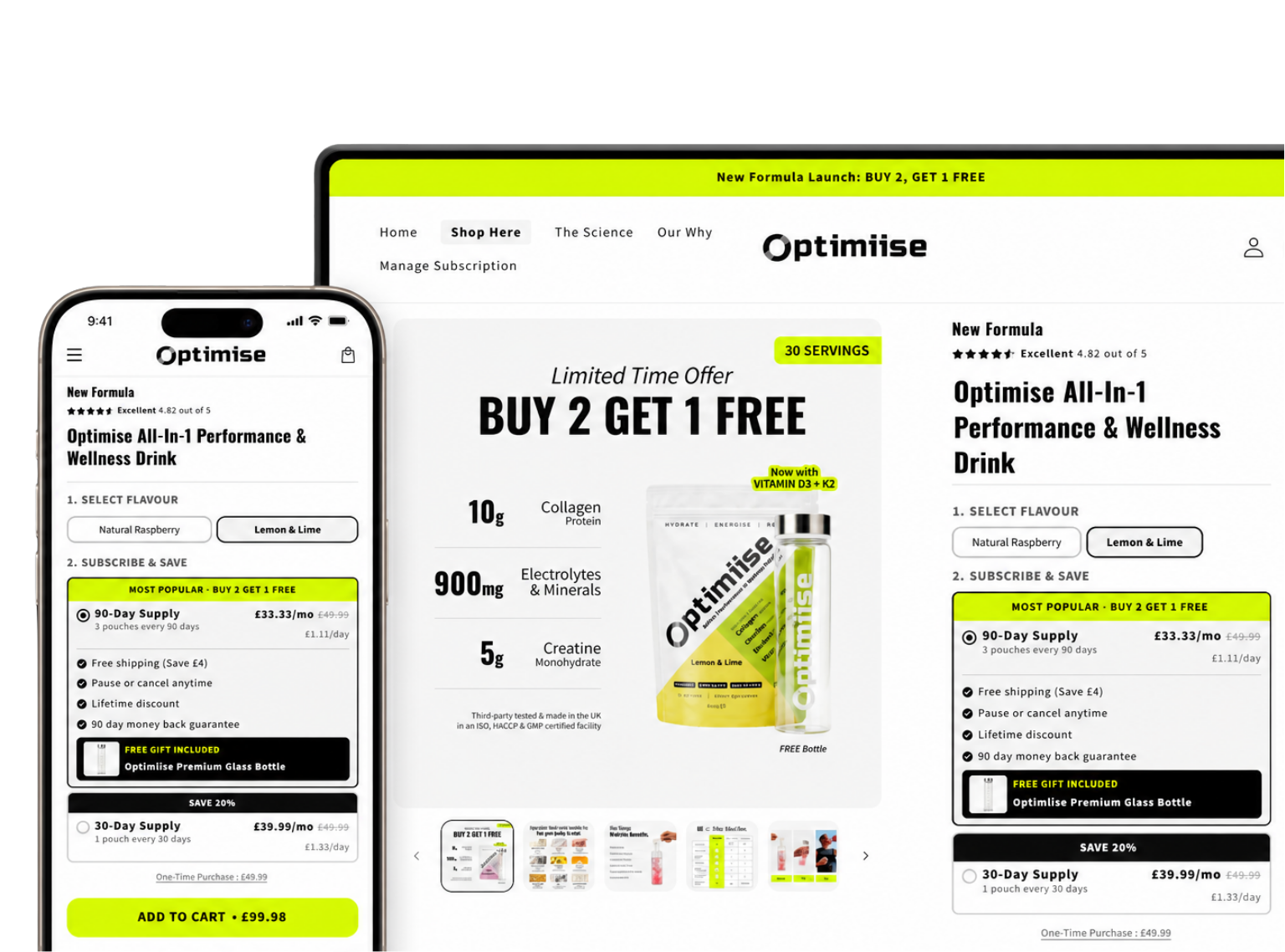
Why Supplements Fit Subscriptions
A supplement is bought once and then measured out. The pack states a serving size, the label states how many servings are inside, and those two numbers give a date the customer runs out. Most products get replaced when somebody notices they are gone. A capsule pack announces its own end date on the box.
- The dose sets the clock. Servings per day and servings per pack are printed facts, so the reorder interval is arithmetic rather than a guess.
- Running out breaks a streak. A routine taken daily loses its point the week it lapses, and that pressure retains better than a discount does.
- Efficacy takes months to show. Whoever keeps supplying through that wait is the brand the customer credits when the effect finally lands.
DrinkAid’s Strategy
The catalogue runs four lines: hangover sachets at S$14.90 for six, gummies at S$17.90, a focus capsule at S$49.90 for thirty servings, and a sleep balm at S$44.90. All four carry a subscription, and all four carry the same one — ten percent off, delivered every one, two or three months.
Everything built for volume is left out. The four bundles are one-time purchases, and so are the multi-packs, where four pouches of gummies get a fifth free and six get three.
Volume discounts and subscription discounts sit on different products here, so a shopper never has to work out which of the two is the better deal.
Each line also runs its own plan group rather than one store-wide schedule. That is how an occasion product and a daily one share an interval menu without sharing a rule.
What Makes It Work
- The two discounts never meet. A page offering both a bulk saving and a subscription saving asks for arithmetic before a purchase. DrinkAid never puts them on one product.
- A flat rate makes the interval a fit question. Ten percent at one month and ten at three means the choice is how fast a pack empties, not how much comes off.
- The occasion product still gets a plan. Hangover sachets are used unevenly, but they live in a drawer, and a drawer that empties is a restock. The plan schedules the cupboard, not the night out.
- Per-line plan groups keep the menus honest. A sleep balm and a focus pack empty at different speeds. Separate groups let each page move on its own.
Key Takeaways
If you sell supplements, or any consumable where a bulk offer and a subscription both make sense:
- Split the two offers across different products. Let the bundle page win the stock-up sale and the single page win the repeat one.
- Hold the subscription rate flat across intervals. Customers then pick the interval that matches their use, which is the interval they keep.
- Put a plan on occasion products too. People refill a cupboard on a schedule even when they use the contents on impulse.
- Give each product line its own plan group. One store-wide schedule forces the slowest product and the fastest onto the same clock.
Build This with Joy Subscriptions
Here is how to build DrinkAid’s split with Joy Subscriptions on Shopify:
- Per-product selling plans - Attach a plan to the single-product pages and leave the bundles alone, so the two offers stay on separate SKUs.
- Custom billing intervals - Offer one, two and three months on one page and let the customer pick the one that matches their pack.
- Customer portal - Subscribers change interval, skip a delivery or swap product without opening a support ticket.
- Subscription analytics - Watch which interval retains longest, which is the only way to learn what a flat rate costs you.
Build the catalogue split before the plans. A subscription added to a page that already runs a bulk offer will lose to it, and you will read that as proof your customers do not subscribe. Free Forever covers the first 50 active subscriptions with no transaction fee, which is enough to find out whether your occasion products restock.