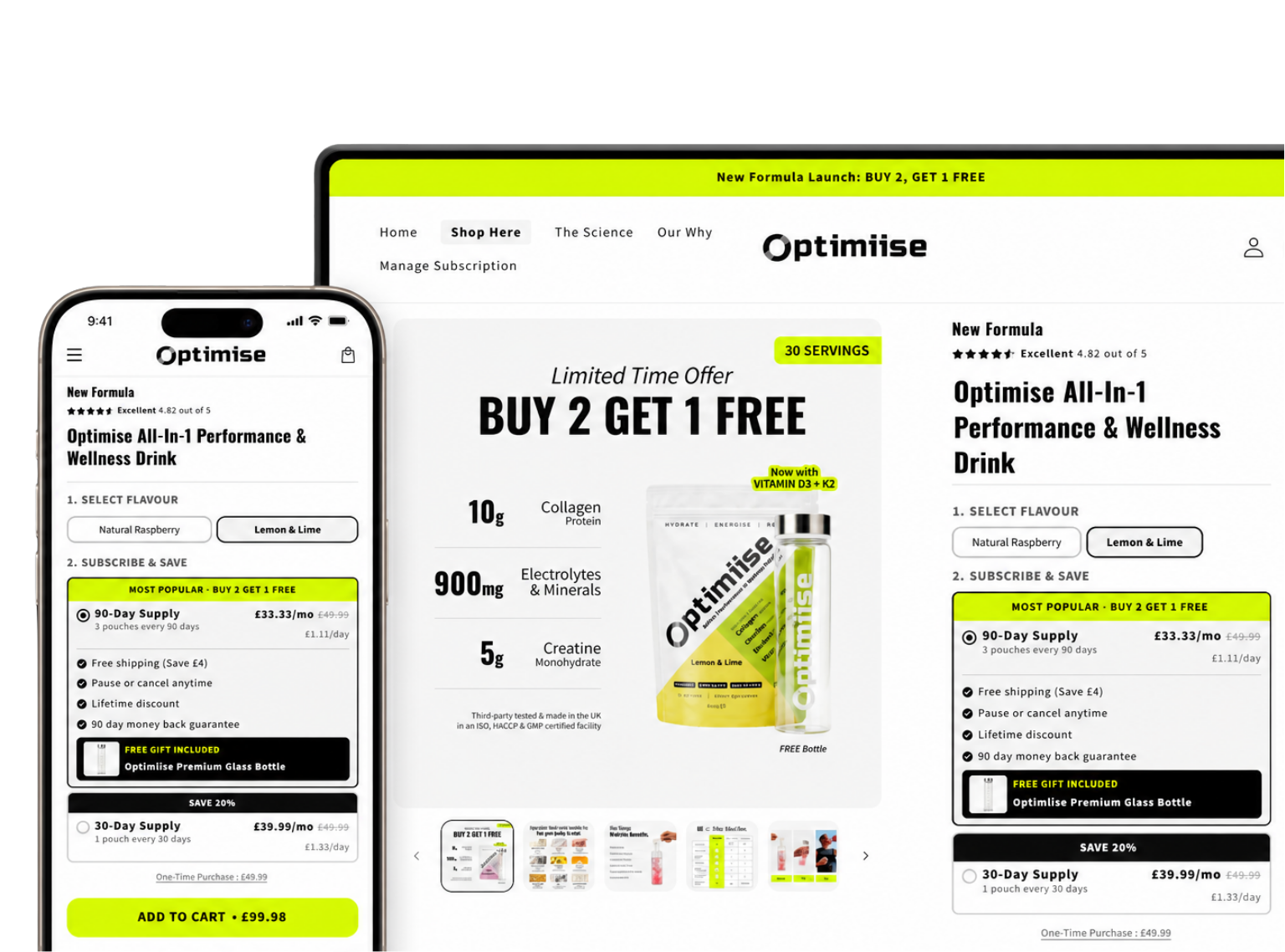
The supplement industry has a subscription problem. Not a demand problem - demand for recurring supplement deliveries is higher than ever. The problem is that most supplement brands treat subscriptions as a reordering convenience rather than a health commitment. They slap a “subscribe & save 10%” badge on a single product and hope customers stick around.
Some do. Most don't. Single-product supplement subscriptions face brutal churn because the switching cost is nearly zero. A customer can find the same fish oil or vitamin D from a dozen other brands, often cheaper. There's no reason to stay loyal to one bottle of one product.
But a different pattern is emerging. Supplement brands that sell protocols - structured, multi-product regimens designed around a health outcome - are seeing meaningfully different results. Higher order values. Longer subscriber lifetimes. Lower churn. And a customer relationship that feels more like following a health plan than buying pills on autopilot.
This article breaks down why the protocol model works, how it compares to other supplement subscription formats, and how to build one on Shopify if you're ready to move beyond single-product subscriptions.
The Supplement Subscription Landscape in 2026
Supplement subscriptions are one of the fastest-growing segments in the broader subscription business model space. The global dietary supplements market is projected to exceed $300 billion by 2028, and a growing share of that revenue is recurring.
Several forces are driving this shift:
- Personalization expectations - Consumers increasingly expect supplements tailored to their goals, not generic multivitamins pulled off a shelf.
- Convenience economics - Auto-replenishment removes the friction of remembering to reorder, and most subscribers are willing to commit in exchange for a modest discount.
- Clinical credibility - Brands with protocol-based positioning (built around practitioners, research, or clinical frameworks) command premium pricing and attract more committed customers.
- Energy & functional wellness - Emerging categories like energy supplements, adaptogens, and natural remedies are expanding the addressable market beyond traditional vitamins.
What's notable is which formats are winning. The supplement subscription box has evolved from curated discovery (think: surprise samples each month) into something more focused. The dominant format in 2026 is the daily pack - a pre-sorted bundle of supplements shipped on a recurring schedule, often tailored to a specific health objective like energy, gut health, or longevity.
Why Protocols Beat Single Products
The difference between selling a single supplement on subscription and selling a protocol is not just a difference in order value. It's a fundamentally different customer relationship.
The psychology of commitment
When a customer subscribes to one bottle of magnesium, they're making a convenience decision. The product is a commodity. Their commitment level is low, and the moment they see a competitor offering a better price or a friend recommends an alternative, they'll cancel without hesitation.
When the same customer subscribes to a protocol - say, a gut health stack with a probiotic, a prebiotic, L-glutamine, and digestive enzymes - they're making a health commitment. The protocol was designed as a system. Removing one piece feels like undermining the whole thing. The customer didn't just choose a product; they chose an approach.
A single-product subscription says “I buy this.” A protocol subscription says “I follow this.” That difference in identity drives everything - retention, referrals, and willingness to pay.
The average order value gap
The math is straightforward. A single-product supplement subscription typically generates $25–$45 per recurring order. A daily pack or protocol subscription - bundling three to six products - naturally lands in the $75–$150 range. That's not just higher revenue per order; it's higher revenue per customer for the entire lifetime of the subscription.
This has cascading effects on your business model. Higher AOV means you can:
- Spend more on customer acquisition (critical in a competitive supplement market)
- Absorb shipping costs more easily
- Offer meaningful discounts without destroying your margins
- Invest more in packaging, inserts, and unboxing experience
For a deeper look at how order values and lifetime revenue interact in subscription businesses, see our guide on customer lifetime value for subscriptions.
The retention advantage
Single-product subscriptions in the supplement space often see monthly churn rates between 8–15%. Protocol subscriptions - especially those with clinical or practitioner-backed positioning - tend to churn at 3–6%. That difference compounds dramatically over a year.
At 10% monthly churn, you retain roughly 28% of subscribers after 12 months. At 4% monthly churn, you retain about 61%. That's not an incremental improvement - it's a completely different business.
We cover the mechanics of reducing churn in detail in our guide to reducing subscription churn.
Three Supplement Subscription Models Compared
Not all supplement subscriptions are created equal. Here's how the three primary formats compare across the metrics that matter most.
| Metric | Single Product | Daily Pack | Full Protocol |
|---|---|---|---|
| Typical AOV | $25–$45 | $50–$90 | $100–$150+ |
| Monthly churn rate | 8–15% | 5–8% | 3–6% |
| 12-month retention | ~15–28% | ~36–53% | ~48–70% |
| Switching cost | Very low | Moderate | High |
| Setup complexity | Simple | Moderate | Higher |
| Brand differentiation | Low (commodity) | Moderate | Strong |
| Customer relationship | Transactional | Convenience-based | Trust-based |
| Best for | Testing demand, simple SKUs | Scaling with bundles | Premium positioning, clinical brands |
Model 1: Single-product subscription
The simplest format. One product, one recurring delivery. Subscribe and save 10–15%. This works when you have a genuinely differentiated product with strong organic demand - think a proprietary formulation or a product with meaningful clinical backing. But for most commodity supplements (fish oil, vitamin D, generic multivitamins), the single-product model is a race to the bottom on price.
Model 2: Daily pack subscription
The daily pack is the most popular format among supplement brands using subscription apps. Customers receive a pre-sorted pouch or box of supplements for each day (or a set number of days). This format naturally increases order value because you're bundling multiple SKUs. The “daily ritual” framing also builds stronger habits - the customer opens a pack each morning, which reinforces the routine and makes cancellation feel like breaking a habit.
Model 3: Full protocol subscription
A protocol goes beyond bundling. It's a structured regimen with a why behind each component. The products aren't just grouped together for convenience; they're designed to work as a system. Protocol-based supplement brands often have clinical advisors, published research, or practitioner partnerships that lend credibility to the formulation.
This is the model with the strongest retention and the highest perceived value. It's also the hardest to replicate, which is exactly why it works. When a customer trusts the protocol, competing on price alone won't pull them away.
Pricing & Margin Analysis for Each Model
Your subscription model directly shapes your pricing strategy. Here's a realistic breakdown of how margins play out across all three formats. For foundational pricing principles, see our subscription pricing strategies guide.
| Factor | Single Product | Daily Pack | Full Protocol |
|---|---|---|---|
| Retail price (one-time) | $30–$50 | $60–$100 | $120–$180 |
| Subscription price | $25–$42 | $50–$85 | $100–$150 |
| Typical discount | 10–15% | 10–20% | 15–25% |
| COGS (estimated) | $5–$12 | $12–$30 | $25–$50 |
| Gross margin | 55–70% | 55–70% | 60–75% |
| Shipping impact | High (relative to AOV) | Moderate | Low (absorbed easily) |
| CAC tolerance | $15–$30 | $40–$70 | $80–$150+ |
The key insight here isn't that protocols have higher margins in percentage terms - they often don't. It's that the absolute margin per subscriber is dramatically higher, and shipping cost is a smaller percentage of the total. When you're spending $8–$12 to ship a single bottle that generates $25 in revenue, shipping eats 30–50% of your gross margin. When you're shipping a protocol box that generates $120 in revenue, that same shipping cost is under 10%.
Pricing tip: Offer your protocol at a per-product discount that's slightly better than buying each supplement individually on subscription, but don't discount so aggressively that you train customers to expect deep cuts. A 15–20% protocol bundle discount is the sweet spot - it's meaningful enough to motivate the bundle, but preserves margin.
The Retention Advantage of Protocol Subscriptions
Retention is where the protocol model truly separates itself. Understanding why protocol subscribers stay longer reveals lessons you can apply regardless of your current format.
Switching costs are structural, not artificial
The best retention doesn't come from lock-in tricks. It comes from making your product genuinely harder to replace. A protocol creates natural switching costs because:
- The customer invested time understanding the regimen and why each component matters
- They've built a daily habit around the specific format (packs, timing, combinations)
- Replacing the protocol means researching alternatives for every component, not just one
- If the protocol was recommended by a practitioner or advisor, switching feels like going against medical guidance
Habit formation compounds retention
Supplement subscriptions live or die on habit strength. The daily pack format - where the customer opens a pre-sorted packet each morning - is powerful because it's a single, repeatable action. Compare this to a single-bottle subscription where the customer has to remember to take a specific dosage from a bottle they might not even keep in a visible location.
The habit loop matters: cue (morning routine), action (open today's pack), reward (feeling of health investment). The more components in the pack, the stronger the ritual feels.
Clinical positioning creates loyalty moats
Supplement brands that frame their subscription as a medical or clinical protocol - backed by a named practitioner, published research, or a proprietary methodology - create a loyalty moat that price competition cannot breach. Customers aren't buying supplements; they're following a program. And people don't casually abandon programs they believe are working.
This is one reason why medical protocol brands in the supplement space show among the lowest churn rates in all of subscription commerce. The perceived cost of leaving isn't financial - it's health-related.
To track how your retention compares, use the subscription analytics frameworks we outline in our subscription analytics & metrics guide.
Building a Supplement Subscription on Shopify
If you're ready to build (or rebuild) your supplement subscription, here's a practical roadmap for getting it right on Shopify.
Step 1: Choose your subscription model
Before touching any technology, decide which format fits your brand, your products, and your customers. Refer to the comparison table above and be honest about where you are:
- Just starting out? A single-product subscription validates demand with minimal complexity.
- Ready to scale? A daily pack or bundle subscription increases AOV and builds stronger habits.
- Have clinical backing or deep expertise? A full protocol subscription is your strongest play for retention and premium pricing.
Step 2: Set up subscription infrastructure
Shopify does not include native subscription billing. You need a subscription app that handles recurring charges, customer self-management, failed payment recovery (dunning), and the subscription widget on your product pages.
Joy Subscriptions is built for exactly this. It supports product bundles natively - which is essential for daily pack and protocol formats - along with a branded customer portal, automated dunning, and subscription analytics. The Free Forever plan covers up to 50 active subscriptions at $0/month, and the paid Starter plan ($49/month + 0.75%) adds analytics with no per-order fee.
Step 3: Configure your subscription plans
For supplements, delivery intervals matter more than in other categories. Most supplement subscriptions offer:
- 30-day delivery - Standard for daily-use supplements. This is the default and most popular.
- 60-day delivery - Works for products with lower daily dosages or where customers want to build a small buffer.
- 90-day delivery - Common for protocols where the brand wants to reduce shipping costs and offer a volume discount.
Set a subscribe-and-save discount that's meaningful but sustainable. For single products, 10–15% off the one-time price is standard. For bundles and protocols, 15–20% works well because the higher AOV makes the discount easier to absorb.
Step 4: Build your product pages for subscription conversion
Your product page needs to clearly communicate why the subscription makes sense - not just that it saves money. For protocol products especially, the page should explain:
- What's in the protocol and why each component is included
- The recommended timeframe to see results (sets expectations and reduces early churn)
- How the daily routine works (with visuals if possible)
- The subscription price versus buying each product individually
Step 5: Set up retention flows
The first 90 days of a supplement subscription are critical. Most cancellations happen in the first two to three billing cycles. Build proactive retention touchpoints:
- Day 1–3: Order confirmation + welcome guide explaining how to get the most from the protocol
- Day 14: Check-in email asking how things are going (not a sales email)
- Day 25: Upcoming renewal reminder with the option to adjust delivery date
- Day 45–60: Educational content about why consistency matters for supplement results
- If they attempt to cancel: Use a cancellation flow (available in Joy Subscriptions' Starter plan) to offer alternatives - pause, skip, or adjust the delivery interval - before processing the cancellation
Compliance & Trust Signals That Matter
Supplement subscriptions operate in a regulated space. Getting compliance right isn't just about avoiding legal trouble - it's a trust signal that directly affects conversion and retention.
Regulatory essentials
- DSHEA compliance (US) - Supplements are regulated as food, not drugs. You cannot make disease-treatment claims (“cures,” “treats,” “prevents”). Structure-function claims (“supports immune health”) are permitted with proper disclaimers.
- GMP certification - Good Manufacturing Practices ensure your products are made consistently and meet quality standards. FDA requires GMP for all supplement manufacturers.
- Supplement Facts labeling - Every product must include a Supplement Facts panel listing all ingredients, serving sizes, and daily value percentages.
- International considerations - If you sell outside the US, regulations vary significantly. The EU has stricter rules on health claims under the European Food Safety Authority (EFSA). Research requirements for each market before expanding.
Trust signals that improve conversions
Beyond compliance, certain trust signals consistently improve supplement subscription conversion rates:
- Third-party testing - NSF International, USP, or ConsumerLab certifications tell customers an independent lab verified what's on the label is actually in the bottle.
- Transparent ingredient sourcing - Where do your ingredients come from? Who manufactures the products? Brands willing to answer these questions publicly build more trust.
- Practitioner endorsements - A named doctor, naturopath, or nutritionist who designed or endorses the protocol adds credibility that generic “doctor-recommended” claims cannot.
- Money-back guarantee - A 30 or 60-day satisfaction guarantee reduces perceived risk, especially for higher-priced protocol subscriptions.
- Visible subscriber count or social proof - “Join 10,000+ subscribers” or customer testimonials about the subscription experience (not just the product) build social proof specifically for the recurring commitment.
Common Mistakes Supplement Brands Make with Subscriptions
Having worked with health and supplement merchants on Joy Subscriptions, we've seen the same mistakes come up repeatedly. Here are the ones that cost brands the most.
Mistake 1: Treating subscription as an afterthought
Too many supplement brands build their entire store around one-time purchases and then bolt on a “subscribe & save” option as an afterthought. The subscription widget is small. The discount is modest. The product page doesn't explain why subscribing makes sense for that specific product. The result? Single-digit subscription adoption rates and high early churn.
If you believe in recurring revenue, design the customer experience around the subscription from day one. The subscription should be the default, not an alternative hidden below the “Add to Cart” button.
Mistake 2: Offering only one delivery interval
Not every customer uses supplements at the same rate. If you only offer a 30-day delivery cycle, customers who take a lower dosage will accumulate unused product, feel wasteful, and cancel. Offering 30, 60, and 90-day options - and making it easy for subscribers to switch between them - prevents this unnecessary churn.
Mistake 3: Ignoring the first 90 days
The first three billing cycles are where you win or lose most subscribers. Brands that send a welcome email and then go silent until the next charge are leaving retention on the table. Use that window to educate, set expectations, and check in. Supplements take time to show results - tell your customers that before they cancel because they “didn't notice a difference” after two weeks.
Mistake 4: Discounting too aggressively
A 30–40% subscription discount attracts price-sensitive buyers who will cancel the moment they find a better deal. A 10–20% discount attracts customers who value the convenience and the product. Your discount should be an incentive, not the primary reason someone subscribes. The goal is to attract people who want your supplement, not people who want any supplement at the lowest price.
Mistake 5: Not tracking the right metrics
Many supplement brands track total subscriber count and MRR but ignore the metrics that actually predict success: subscriber churn by cohort, time to first cancellation, pause-to-cancel ratio, and reactivation rate. Without these, you're flying blind. Set up proper subscription analytics from the start - not after you notice a problem.
Mistake 6: Skipping cancellation flows
When a subscriber clicks “cancel,” that's not the end of the conversation - it's the beginning. A well-designed cancellation flow offers alternatives (pause, skip, change frequency, swap products) and collects feedback on why the customer is leaving. Many subscribers who enter a cancellation flow end up choosing a pause or adjustment instead. If you're not using one, you're losing recoverable subscribers every month.
Where to Go from Here
If you're selling supplements on Shopify and your subscription strategy is limited to a single product with a small discount, you're competing on the wrong axis. Price-sensitive supplement buyers are the hardest to retain and the most expensive to reacquire.
The brands that are winning in this space have shifted their positioning from “convenient reorder” to “health protocol.” They bundle products into daily packs or structured regimens. They invest in the first 90 days of the subscriber journey. They use clinical credibility and transparent sourcing as competitive moats. And they measure retention with the same rigor they apply to acquisition.
You don't need to overhaul everything at once. Start by bundling your two or three most complementary products into a daily pack. Set up a proper delivery cadence. Build a 90-day onboarding sequence. And choose a subscription platform that supports bundles, cancellation flows, and real analytics from the start.
Joy Subscriptions is free to start and built for exactly this kind of setup. If you want to dive deeper into the fundamentals first, our subscription business model guide covers the full landscape.