Pricing is one of the highest-leverage decisions you will make for your subscription business. A small change — even a few percentage points — compounds over every subscriber, every billing cycle, for as long as they stay. That is why getting it right matters more for subscriptions than for almost any other business model.
Yet most merchants spend far more time on acquisition and marketing than on pricing. They pick a number that “feels right,” launch, and never revisit it. That approach leaves real money on the table.
This guide covers the practical strategies for pricing subscriptions — from choosing a pricing model and calculating your numbers, to the psychology behind what makes a price feel fair, to knowing when and how to raise prices without losing subscribers.
Why Subscription Pricing Is Different From One-Time Pricing
When you sell a product once, the pricing equation is relatively simple: cost plus margin. The customer evaluates the price against the perceived value of owning that product, makes a decision, and moves on.
Subscription pricing adds several layers of complexity:
- The customer evaluates ongoing value, not just one-time value. They are not asking “Is this worth $30?” — they are asking “Is this worth $30 every single month?” That is a fundamentally different psychological calculation.
- Retention matters as much as acquisition. A price that attracts subscribers but causes them to cancel after two months is worse than a slightly higher price that keeps them for a year. Customer lifetime value (CLV) is the metric that matters, not just conversion rate.
- Small price changes have compounding effects. If you have 500 subscribers and raise your price by $2/month, that is $12,000 in additional annual revenue — without acquiring a single new customer. Eightx's 2026 DTC benchmark shows subscription customers deliver 3–5x the lifetime value of one-time buyers at the same gross margin, which amplifies every pricing decision.
- The anchoring is different. Customers compare your subscription price against the one-time price of the same product, against competitor subscriptions, and against all the other subscriptions already pulling from their monthly budget.
Understanding these differences is the foundation for every pricing decision that follows. The strategies below are built on this reality.
Common Subscription Pricing Models
One-time pricing has to win an argument once. Subscription pricing has to keep winning it every cycle, against a customer who grows more familiar with what they are paying for.
Before you set a specific number, you need to choose a pricing structure. Here are the five most common models, with their strengths and where they fit best.
| Pricing Model | How It Works | Best For | Example |
|---|---|---|---|
| Flat-Rate | One price, one set of features or products, same for everyone | Simple products, single-SKU stores | $25/month for a monthly coffee delivery |
| Tiered | Multiple price points with increasing value at each level | Businesses with varied customer segments | Basic ($15), Standard ($25), Premium ($40) |
| Usage-Based | Price scales with consumption or usage volume | SaaS, API services, variable-consumption products | $0.10 per API call, or price per unit shipped |
| Freemium | Free basic tier with paid upgrades for premium features | Digital products, SaaS, content | Free plan with limited features, $29/month for full access |
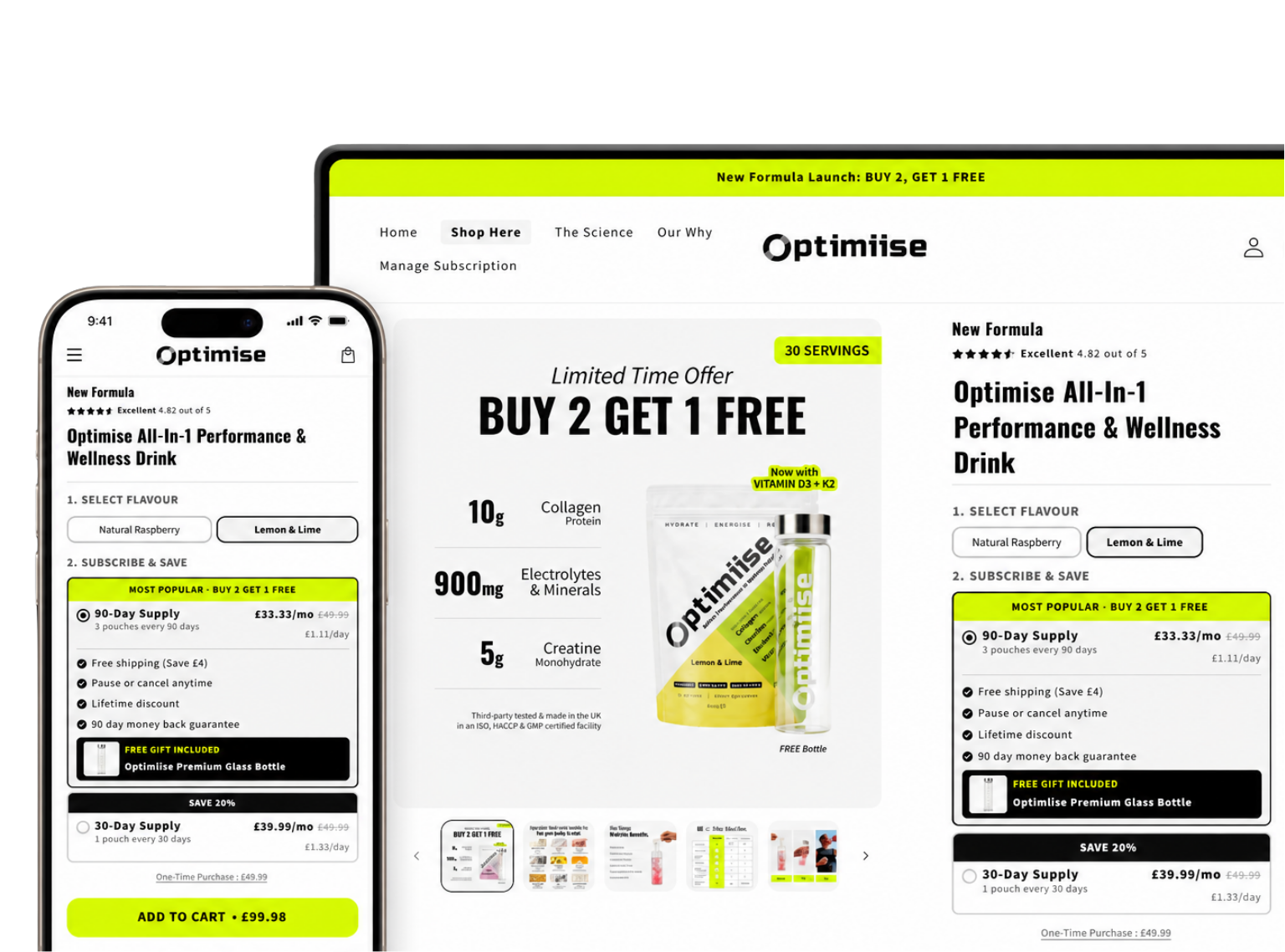
| Subscribe & Save | Discount off the one-time price in exchange for recurring commitment | Physical products, consumables, replenishables | One-time: $30, Subscribe & Save: $25.50 (15% off) |
Which Model Fits Your Store?
For most Shopify merchants selling physical products, subscribe and save is the natural starting point. It is simple for customers to understand (“save 10–15% when you subscribe”), easy to implement, and does not require you to create entirely new product offerings.
Tiered pricing works well when you can offer meaningfully different levels of value — for example, a basic subscription box with 3 items, a standard with 5, and a premium with 8. The key word is “meaningfully.” If the tiers feel arbitrary, customers will just pick the cheapest one.
Flat-rate is the simplest to manage and communicate, but it limits your ability to capture value from customers who would pay more. It works best when your product or box is consistent and you are confident in the price point.
Freemium and usage-based models are less common for physical product subscriptions, but they show up in digital subscriptions and SaaS contexts.
How to Set Your Subscription Price
Margin tip: Model your price against the third order, not the first. Acquisition discounts and first-box costs distort the opening cycle; the third order is where you find out whether the subscription is actually profitable.
Once you have chosen a model, you need to arrive at an actual number. Here is the practical framework.
Step 1: Know Your Costs (COGS + Fulfillment)
Start with the hard numbers. For each subscription order, calculate:
- Product cost (COGS): What you pay for the product itself — raw materials, manufacturing, or wholesale cost.
- Packaging: Box, inserts, branded tissue, labels.
- Shipping: Average cost per shipment, including zones you ship to most.
- Payment processing: Typically 2.9% + $0.30 per transaction on Shopify.
- App and platform fees: Subscription app costs, Shopify plan fees allocated per order.
Add these up. This is your fully loaded cost per subscription order. Your price must be above this number — the gap between cost and price is your margin.
Step 2: Set Your Target Margin
For physical product subscriptions, healthy gross margins typically fall between 40% and 65%. According to Eightx's 2026 DTC benchmark analysis of public companies, the median DTC gross margin sits at 56.6%, with subscription-focused brands clustering in the 40–60% range and beauty/wellness brands hitting 65–70%. If your margin is below 30%, you will struggle to cover acquisition costs and run the business sustainably.
Here is a quick calculation:
If your fully loaded cost per order is $18 and you want a 50% gross margin:
Price = Cost ÷ (1 - Target Margin) = $18 ÷ 0.50 = $36/month
That gives you $18 per order to cover overhead, marketing, and profit. Run this calculation with different margin targets (40%, 50%, 60%) to see where your price needs to land.
Step 3: Check Against Competitors
Your cost-based price is a floor, not a ceiling. Now look at what competitors charge for similar subscriptions:
- Search for subscription offerings in your niche on Shopify, Amazon, and direct-to-consumer sites.
- Note their pricing, what is included, and what discount they offer for subscribing.
- Identify where you can differentiate — better product quality, more customisation, better customer experience.
You do not need to be the cheapest. In fact, being the cheapest in a subscription market often signals low quality. The goal is to be fairly priced relative to the value you deliver.
Step 4: Validate With Value Perception
The final check: does your price feel right to the customer? Two techniques help here:
- The “would I pay this?” test. Put yourself in your customer’s shoes. If you were buying this subscription at this price, every month, for a year — would you feel good about it?
- The Van Westendorp method. Survey a small group of target customers with four questions: At what price would this be so cheap you would doubt its quality? At what price is it a bargain? At what price is it getting expensive? At what price is it too expensive? The overlap gives you an acceptable price range.
Subscribe & Save Discount: How Much Is Enough?
If you are using a subscribe-and-save model on Shopify, the discount percentage is one of the most important decisions you will make. Too small and customers see no reason to subscribe. Too large and you erode your margins for minimal gain in retention.
The 10–15% Guideline
Across most product categories, 10–15% off the one-time price is the sweet spot for subscribe-and-save discounts. This aligns with platform precedent: Amazon's Subscribe & Save program caps the customer-facing discount at 15% (5% base plus a 10% bonus for five or more items in the same delivery), and Recurly's subscription pricing research shows industry medians falling between 10–30% across tiers. Here is why this range works:
- Below 10%: The savings feel negligible. On a $30 product, 5% off is $1.50 — not enough to motivate a recurring commitment.
- 10–15%: The savings are noticeable and feel fair. On a $30 product, that is $3–$4.50 off per order, which adds up to $36–$54 per year. That is tangible.
- Above 20%: Can work for high-margin products, but you need to be sure your margins support it. The risk is attracting discount-driven customers who cancel as soon as they find a better deal.
Category-Specific Guidance
Coffee and tea: 10–15%. Supplements: 15–20%. Pet food: 10–15%. Skincare: 10–15%. Household essentials: 15–20%.
With Joy Subscriptions, you can set different discount percentages per product or subscription plan.
Start with the numbers, test with real customers, and let the data guide your decisions.