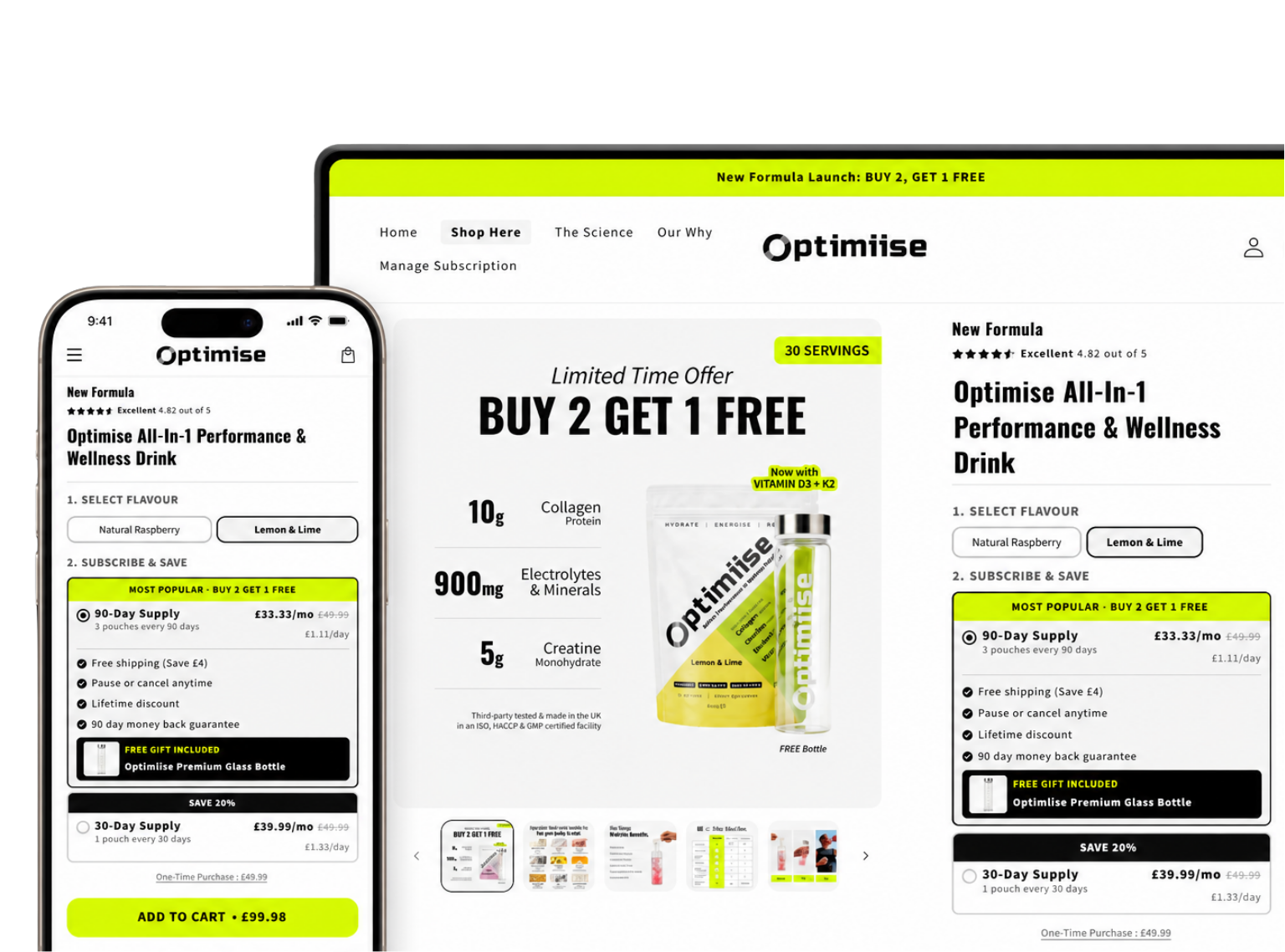
Subscriptions are not new. Newspapers, milk deliveries, and magazine subscriptions have existed for over a century. What has changed is the scale. In the last decade, the subscription model has expanded from software and media into nearly every product category - from coffee and vitamins to pet food and razors. For ecommerce merchants, subscriptions represent a shift from chasing new customers every month to building lasting relationships with the ones you already have.
This guide explains the subscription business model from the ground up. We'll cover what it is, the main types, why it's growing, the honest benefits and challenges, and how to get started if you run a Shopify store. No jargon, no hype - just what you need to know to decide whether this model makes sense for your business.
What Is a Subscription Business Model?
At its core, a subscription business model replaces one-time purchases with recurring ones. The customer agrees to pay at regular intervals, and in return they receive a product, a service, or access to something of value on an ongoing basis.
The key difference from traditional retail is the relationship structure. In a one-time purchase model, the transaction ends at checkout. The merchant got paid, the customer got their product, and unless the merchant can convince that customer to come back and buy again, the relationship is over. In a subscription model, the transaction is the beginning. Revenue continues as long as the customer stays subscribed.
This changes the economics of the business in fundamental ways. Instead of measuring success by how many new customers you acquired this month, you measure it by how many customers stayed - and how much recurring revenue they represent. The metrics shift from conversion rate and average order value to monthly recurring revenue (MRR), customer lifetime value (CLV), and churn rate.
For the customer, the value proposition is straightforward: convenience, consistency, and often a better price. They don't have to remember to reorder. The product shows up when they need it. And in many cases, subscribing earns them a discount they wouldn't get buying one-off.
Types of Subscription Models
Recurring revenue is not a pricing change. It is a promise to keep being worth paying for, renewed every single billing cycle.
Not all subscriptions work the same way. The model you choose depends on what you sell, who your customers are, and what kind of value you're delivering on a recurring basis. Here are the four main types - and where each one fits best.
1. Subscribe & Save (Replenishment)
This is the most common subscription model in ecommerce. The customer selects a product they already buy - coffee, vitamins, skincare, pet food - and commits to receiving it on a recurring schedule. In exchange, they get a discount, typically 10-20% off the one-time price.
Amazon popularised this model, and it works because it solves a real problem: the customer was going to buy the product anyway, and now they don't have to remember to do it. The merchant benefits from predictable orders and higher lifetime value per customer.
Best for: Consumables and replenishable products - anything customers use up and need to replace regularly. Coffee, supplements, household supplies, baby products, and pet food are classic examples.
2. Curation / Subscription Box
In this model, the merchant selects and packages a curated collection of products - often themed or personalised - and ships it to subscribers on a regular schedule. The customer pays a flat fee per box, and the excitement comes from discovery and surprise.
Think of monthly snack boxes, beauty sample subscriptions, or book clubs. The value isn't just the products - it's the curation. Someone with expertise is choosing items the customer might not have found on their own.
Best for: Products where discovery and variety are part of the appeal. Specialty food, beauty, books, craft supplies, and niche hobbies. Curation boxes also work well as gifts.
3. Access / Membership
Here, the subscription gives the customer access to exclusive benefits - members-only pricing, early access to new products, free shipping, gated content, or a community. The subscription fee is the price of entry, and the ongoing value comes from the perks.
This model works differently from Subscribe & Save because the customer isn't necessarily receiving a product each billing cycle. They're paying for status, savings, or experiences that are only available to members. Costco's membership model is a well-known example. In ecommerce, you might see a skincare brand offering a VIP membership that includes a monthly discount code, free shipping on all orders, and early access to new product launches.
Best for: Brands with a loyal customer base and enough product range to make ongoing membership valuable. Works well when combined with other subscription types.
4. Usage-Based
In a usage-based model, the customer pays based on how much they use during each billing cycle. This is more common in software and services (cloud storage, API calls, utility bills) than in physical products, but some ecommerce businesses use variations of it - for example, a printing service that charges per page printed each month.
Best for: Services and digital products where consumption varies. Less common in physical ecommerce but worth understanding as part of the landscape.
Which Type Should You Choose?
| Model | Customer Gets | Merchant Effort | Best Starting Point? |
|---|---|---|---|
| Subscribe & Save | Same product on repeat, at a discount | Low - uses existing products | Yes - simplest to launch |
| Curation / Box | Curated selection, often a surprise | High - sourcing, packaging, variety | Only if curation is your strength |
| Access / Membership | Exclusive perks, discounts, or content | Medium - requires ongoing value creation | Good add-on, not usually the first step |
| Usage-Based | Pay for what they use | Variable - needs metering | Rare in ecommerce |
If you're an ecommerce store exploring subscriptions for the first time, Subscribe & Save is almost always the easiest starting point. It uses products you already sell, requires minimal operational changes, and gives customers a clear reason to subscribe. You can always layer on curation or membership later.
Why Subscription Models Are Growing
The subscription economy has been growing steadily for over a decade, and 2026 is no exception. The Business Research Company's 2026 subscription ecommerce report projects the market growing from $536B in 2025 to roughly $860B in 2026. Several forces are driving this trend - and they're worth understanding because they explain why the model works, not just that it does.
Customer acquisition costs keep rising. Paid advertising on platforms like Meta and Google has become significantly more expensive over the past five years. When it costs more to acquire each new customer, the math only works if that customer buys more than once. Subscriptions are a direct answer to this problem: they extend the revenue you earn from each acquisition.
Customers want convenience. The shift toward auto-replenishment isn't merchant-driven - it's customer-driven. People are busy. If they can set up automatic delivery of their coffee, their dog food, or their face wash and not think about it again, many will. The subscription removes friction from a purchase they'd make anyway.
Predictable revenue changes what's possible. When you know roughly how much revenue is coming next month, you can plan inventory more accurately, invest in growth with more confidence, and negotiate better rates with suppliers. One-time sales are inherently unpredictable. Recurring revenue smooths out the volatility.
The tools have caught up. Five years ago, setting up subscriptions on Shopify was technically challenging and expensive. Today, apps like Joy Subscriptions make it possible to go from zero to a working subscription offering in under an hour, often on a free plan. The barrier to entry has dropped dramatically.
Retention matters more than ever. With rising acquisition costs and more competition in every niche, brands that retain customers have a structural advantage over brands that don't. Subscriptions are one of the most direct ways to improve retention - not by locking customers in, but by giving them a reason to keep coming back.
Benefits of the Subscription Model for Merchants
The benefits of recurring revenue are real, but they're also sometimes overstated in marketing content. Here's an honest breakdown of what subscriptions actually give you - and what they don't.
Predictable, Recurring Revenue
This is the headline benefit, and it's genuine. When you have 500 active subscribers paying $30 per month, you know that roughly $15,000 in revenue is coming next month before you spend a single dollar on marketing. That predictability changes how you run your business. You can forecast inventory, plan hiring, and budget for growth with actual numbers instead of guesses.
The caveat: "predictable" doesn't mean "guaranteed." Churn happens. Payment failures happen. Your actual revenue will always be slightly less than your theoretical MRR. But even with churn factored in, subscription revenue is far more stable than one-time sales alone.
Higher Customer Lifetime Value (CLV)
A subscriber who stays for 12 months at $30/month is worth $360. A one-time buyer who purchases the same product once is worth $30. Even if the subscriber gets a 15% discount, their lifetime value is dramatically higher. This is the fundamental economic advantage of subscriptions: each customer relationship is worth more over time. Eightx's 2026 DTC benchmark quantifies this gap: subscription customers generate 3–5x the lifetime value of one-time buyers at equivalent gross margins.
The practical effect is that you can afford to spend more to acquire each customer - because you'll earn it back over months, not in a single transaction. This gives subscription businesses a structural advantage in paid advertising and customer acquisition.
Lower Customer Acquisition Cost (CAC) Over Time
Every month a subscriber stays, the effective cost of acquiring them drops. If you spent $20 to acquire a customer who subscribes for 10 months, your effective CAC per transaction is $2. Compare that to spending $20 to acquire a customer who buys once. The math is straightforward: retention amortises acquisition costs.
Better Inventory Planning
When you know that 300 subscribers need a 30-day supply of your product next month, you can order exactly what you need. Compare that to trying to forecast demand for one-time purchases, which can swing wildly based on a promotion, a social media post, or the weather. Subscriptions reduce waste and stockout risk.
Stronger Customer Relationships
Subscriptions create more touchpoints with your customers. Each billing cycle is a chance to communicate - a shipping notification, a personalised recommendation, a check-in email. Over time, this builds a relationship that's harder for competitors to disrupt. A customer who's been subscribing to your coffee for six months is much less likely to switch than one who bought a single bag.
Common Challenges with Subscription Businesses
Subscriptions aren't a magic fix. They come with real operational and strategic challenges that you should understand before committing. Here's what to watch for.
Churn
Churn - the rate at which subscribers cancel - is the single most important metric in a subscription business. Even a churn rate that looks small on paper compounds fast. At 5% monthly churn, you lose roughly half your subscriber base in a year. At 10%, you lose two-thirds.
Some churn is unavoidable. Customers move, change preferences, or simply don't need the product anymore. But a lot of churn is preventable with the right approach: let customers pause instead of cancelling, offer to adjust their frequency, send upcoming order reminders so charges aren't a surprise, and make the cancellation process honest (no dark patterns - if someone wants to leave, let them leave cleanly).
Payment Failures (Involuntary Churn)
Not all cancellations are intentional. Expired credit cards, insufficient funds, and bank-flagged transactions cause what's called involuntary churn - the customer didn't mean to cancel, but their payment failed. According to FlyCode's 2026 payment recovery analysis, failed payments account for 20–40% of all subscription churn.
The solution is dunning management: automated retry logic that attempts the payment again after a waiting period, combined with email or SMS notifications asking the customer to update their payment method. PayRequest's 2026 benchmark shows merchants with comprehensive dunning recover 70–80% of failed payments vs. only 20–31% with basic retry alone. Good subscription apps handle this automatically. Joy Subscriptions, for example, includes smart retry logic that spaces out payment attempts to maximise recovery rates.
Logistics and Fulfilment Complexity
Subscriptions add a layer of complexity to your operations. You're now managing recurring orders alongside one-time orders, which means your fulfilment process needs to handle both. If you're doing the fulfilment yourself, that might mean batching subscription orders on specific days. If you use a 3PL, you'll need to make sure they can handle the volume and timing of recurring shipments.
For Subscribe & Save models, this is usually manageable because you're shipping the same products. For curation boxes, it's more complex because you're assembling unique packages each cycle.
Finding the Right Discount
If your subscription discount is too low, customers won't bother subscribing. If it's too high, you're giving away margin without a proportional increase in retention. Finding the right balance takes testing. Most stores start at 10-15% and adjust based on data - subscription conversion rate, churn rate, and margin impact.
Customer Expectations
Subscribers expect a higher level of service than one-time buyers. They're in an ongoing relationship with your brand, and if something goes wrong - a late shipment, a quality issue, a confusing charge - the impact on trust is amplified. You need clear communication, an easy-to-use customer portal, and responsive support.
How to Start a Subscription Business on Shopify
Start tip: Do not launch a new product as a subscription. Launch a subscription on the product customers already re-order most - you will learn how subscriptions behave against demand you can already predict.
If you're running a Shopify store and want to add subscriptions, here's the practical path. This isn't theory - it's the steps merchants actually follow to go live.
Step 1: Choose Your Subscription Model
Decide which type fits your products. For most Shopify stores selling physical products, Subscribe & Save is the natural starting point. If you sell curated collections or want to offer a membership tier, those are options too - but they require more operational setup. Start with the simplest model that makes sense for your product.
Step 2: Install a Subscription App
Shopify doesn't include subscription functionality natively. You need a subscription app that handles the recurring billing logic, the subscribe option on your product pages, the customer self-service portal, and payment failure recovery.
Joy Subscriptions handles all of this and offers a Free Forever plan ($0/month, up to 50 active subscriptions), so you can test the model without a monthly software cost. Install the app, and it integrates directly with your Shopify store and checkout.
Step 3: Select Your Products
Don't try to make everything subscribable on day one. Pick one to three products that have the strongest reorder potential - products customers already buy repeatedly. These are your best candidates because the subscription adds convenience to a behaviour that already exists.
Step 4: Set Your Pricing and Frequency
Choose your subscription discount (10-15% is a solid starting point) and the delivery frequencies you'll offer. Common intervals are every two weeks, every month, every six weeks, and every two months. Match the frequency options to how quickly your customers actually use the product. A 30-day supply of vitamins makes sense on a monthly cadence. A premium candle might be better at every six or eight weeks.
Step 5: Configure the Customer Experience
Set up the customer portal so subscribers can manage their own subscriptions - skip, pause, change frequency, swap products, update payment methods. The more control you give customers, the less support overhead you'll have and the more trust you'll build.
Also configure your email notifications: order confirmations, upcoming charge reminders, payment failure alerts, and skip/pause confirmations. Clear communication reduces surprise charges and the support tickets that follow.
Step 6: Launch and Iterate
Go live with your subscription offering and watch the data. Track your subscription conversion rate (what percentage of buyers choose to subscribe), your churn rate, and your margin impact. Give it at least 60-90 days before drawing conclusions - subscription businesses take time to build momentum.
For a detailed technical walkthrough, see our guide: How to Add Subscriptions to Your Shopify Store.
Is the Subscription Model Right for Your Store?
Not every store should add subscriptions. The model works well under specific conditions, and being honest about whether those conditions apply to your business will save you time and effort.
Subscriptions make sense when:
- You sell consumable or replenishable products that customers reorder regularly
- You have enough margin to offer a meaningful discount (10%+) without losing money
- Your customers are brand-loyal - they prefer your product over alternatives
- You're willing to invest in the customer experience (portal, communication, support)
- You want more predictable revenue and are willing to focus on retention, not just acquisition
Subscriptions may not make sense when:
- Your products are one-time purchases with no natural reorder cycle (furniture, electronics)
- Your margins are too thin to sustain a recurring discount
- Your customers buy based on impulse or trends rather than routine
- You don't have the operational capacity to handle recurring fulfilment reliably
The honest answer is that subscriptions work best when they align with how your customers already behave. If your repeat purchase rate is already decent, subscriptions formalise and accelerate that pattern. If customers rarely come back, subscriptions won't fix the underlying problem - you need to work on your product-market fit first.
If the conditions are right, the subscription model is one of the most effective ways to build a more stable, more valuable ecommerce business. Start small, test with a few products, measure what matters, and expand what works. That's the practical path - and it's how most successful subscription businesses got started.