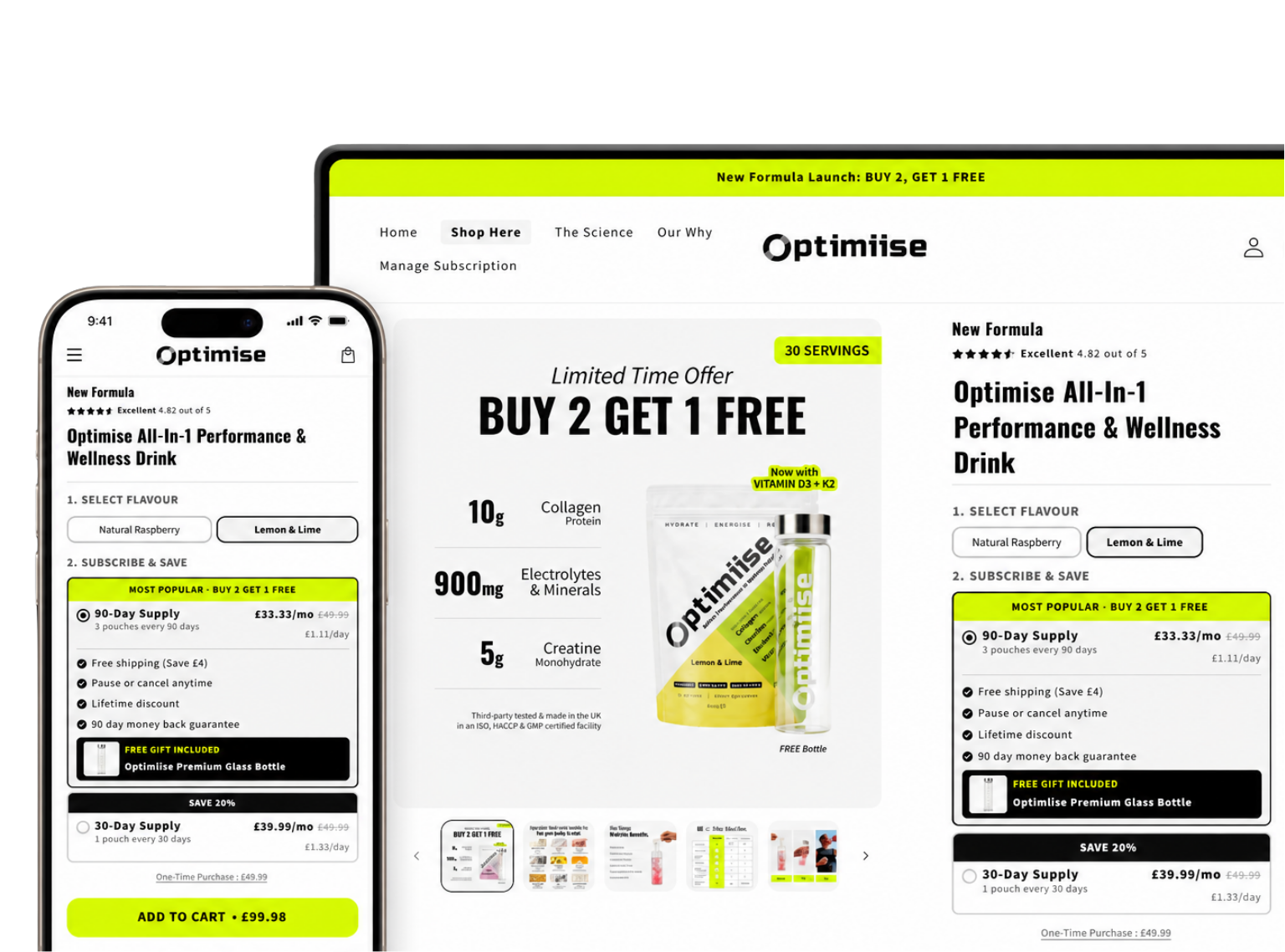
When you look at subscription stores on Shopify, a pattern emerges quickly. Some stores have a small number of subscribers generating significant revenue. Others have thousands of subscribers but more modest revenue per person. Both can be highly profitable — but they require fundamentally different strategies to build and sustain.
This is not about which path is "better." It is about which path fits your product, your market, and your operational strengths. Getting clarity on this question early saves you from chasing the wrong metrics and copying strategies that were never designed for your type of business.
This guide breaks down both paths — the economics, the acquisition playbooks, the retention strategies, and the metrics that actually matter for each one. If you are building or growing a subscription business on Shopify, this framework will help you make sharper decisions.
The Two Paths to Subscription Revenue
Every subscription store sits somewhere on a spectrum. On one end, you have stores where each subscriber is worth a lot — high ticket items, premium positioning, curated experiences. On the other end, you have stores where the power comes from sheer numbers — affordable replenishment products that thousands of people need on a regular schedule.
Here is the simplest way to think about it:
Total Subscription Revenue = Number of Active Subscribers × Average Order Value × Average Order Frequency
Every subscription business pulls on these three levers. But the high AOV path and the high volume path pull on very different ones — and that changes everything about how you operate. For context, Eightx's 2026 DTC benchmark analysis of public companies shows median DTC gross margins at 56.6%, with subscription-focused brands clustering in the 40–60% range and premium beauty/wellness brands hitting 65–70%. Where your margins sit largely determines which path is viable.
Why this framework matters
Most subscription advice treats all stores the same. "Reduce churn." "Increase AOV." "Grow your subscriber base." That advice is not wrong, but it is incomplete. The specific tactics that work depend on which path you are on.
A premium meat subscription box running at $150+ per order needs a completely different retention approach than a $15/month cat litter refill. The first needs to justify ongoing luxury. The second needs to be so effortless that cancelling feels like more work than continuing.
Understanding your path means you can stop guessing and start building a strategy that matches your actual business model.
The High AOV Path: Fewer Subscribers, Higher Revenue Per Subscriber
High AOV forgives a small subscriber base and punishes every cancellation. High volume forgives churn and punishes a thin margin. Pick the failure mode you can survive.
High AOV subscription stores typically operate in premium, curated, or luxury categories. Each subscriber represents significant recurring revenue, and the business can thrive with a relatively small but highly engaged customer base.
Industries and product types
From looking at cross-industry patterns across subscription stores, high AOV models tend to cluster around:
- Premium food & beverage: Curated meat boxes, artisan food subscriptions, wine and spirits selections. These combine high product costs with a curation premium that customers are willing to pay for.
- Luxury lifestyle products: Premium pet furniture and accessories, high-end home goods, designer items delivered on a recurring basis.
- Specialty health & wellness: Medical device refills, premium supplements, professional-grade skincare. Products where quality justification supports higher price points.
- Digital memberships with premium positioning: Exclusive content, coaching, or community access priced at a premium tier.
The economics
The math behind the high AOV path has distinct characteristics:
- Higher margins per order: Premium products typically carry better margins. A $120 subscription box with 55% margins gives you $66 in gross profit per order — compared to $5.25 from a $15 product at 35% margins.
- Lower churn rates: Customers who commit to high-value subscriptions tend to be more intentional about their purchase. They researched, compared, and chose deliberately. That intent translates to stickier relationships.
- Higher acquisition costs are sustainable: When each subscriber is worth $1,000+ per year in revenue, you can afford to spend more on customer acquisition — paid ads, influencer partnerships, sampling programs — and still maintain healthy unit economics. Eightx's 2026 DTC benchmark shows subscription customers generate 3–5x the lifetime value of one-time buyers at equivalent gross margins, which is what makes high-CAC acquisition strategies pencil out for premium subscription stores.
- Slower growth curve: The trade-off is that acquiring each new subscriber takes more effort. The audience is smaller, the consideration period is longer, and the sales process often requires more trust-building.
Geographic patterns
High AOV subscription models tend to perform well in markets with higher disposable income — the US, Western Europe, Australia, and similar markets. This is not a hard rule, but it is a consistent pattern. Luxury positioning requires an audience that can absorb the price point without friction.
The High Volume Path: Many Subscribers, Lower Revenue Per Subscriber
High volume subscription stores win by making it easy, affordable, and automatic for large numbers of customers to subscribe. The individual order value is modest, but the aggregate numbers add up quickly.
Industries and product types
High volume models tend to appear in:
- Replenishment essentials: Pet food and treats, cat litter, household cleaning supplies — products people need regularly and predictably. The subscription eliminates the chore of reordering.
- Self-care and wellness kits: Affordable skincare routines, wellness supplements, personal care bundles. High emotional appeal at accessible price points.
- Curated discovery at accessible prices: Fashion accessories, lifestyle boxes, stationery kits. The "surprise and delight" factor drives subscriptions, and the lower price point reduces the commitment barrier.
- Education and training: Online course access, learning materials, digital resource subscriptions. Easy to scale with minimal marginal cost per subscriber.
The economics
- Volume compensates for lower per-subscriber revenue: A store with 2,000 subscribers at $20/month generates $40,000 in monthly recurring revenue. You need scale, but the math works when acquisition is efficient.
- Lower acquisition costs are essential: Because each subscriber contributes less revenue, you cannot afford expensive acquisition channels for long. Organic search, word-of-mouth, and viral mechanics become critical.
- Higher churn is the core challenge: Lower-commitment purchases are easier to cancel. Customers at the $15–$25 price point will pause or cancel more readily than those at $100+. FlyCode's 2026 payment recovery analysis finds failed payments alone account for 20–40% of all subscription churn — and that share hits high-volume stores harder because they're processing more billing attempts. Churn reduction becomes the single most important operational focus.
- Operational efficiency matters more: With thousands of orders per month, every inefficiency in fulfillment, customer service, and logistics gets multiplied. Automation is not optional — it is survival.
Geographic patterns
High volume models tend to work across a wider range of markets, including emerging economies. The lower price point makes subscriptions accessible to a broader audience. We see strong volume-based subscription stores across the US, Japan, Brazil, Spain, Germany, and beyond.
Side-by-Side: High AOV vs. High Volume
Here is a direct comparison to help you see how these two paths differ across the metrics that matter most.
| Metric | High AOV Path | High Volume Path |
|---|---|---|
| Typical order value | $75 – $300+ | $10 – $40 |
| Subscriber count needed | Hundreds to low thousands | Thousands to tens of thousands |
| Customer acquisition cost (CAC) | Higher ($30–$80+), but sustainable | Must stay low ($5–$20) |
| Churn rate | Lower (3–6% monthly) | Higher (7–12% monthly) |
| Customer lifetime value | High per subscriber | Lower per subscriber, high in aggregate |
| Growth curve | Slower, steadier | Faster potential, more volatile |
| Primary risk | Acquisition bottleneck | Churn spiral |
| Key operational focus | Customer experience & curation | Automation & fulfillment efficiency |
| Best acquisition channels | Content, influencers, referrals | SEO, social media, paid ads at scale |
| Retention lever | Personalisation & exclusivity | Convenience & habit formation |
Neither column is inherently better. What matters is alignment — your product, your pricing, your operations, and your growth strategy should all point in the same direction.
Which Path Fits Your Business?
If you are not sure which path to pursue, ask yourself these questions:
Choose the high AOV path if:
- Your product costs $50+ per unit or you can bundle products into a premium package
- Your product has a strong curation, artisan, or luxury angle
- Your target customer values quality over price and is willing to commit
- You can deliver a differentiated experience that justifies premium pricing
- You have strong storytelling and brand-building capabilities
- You are comfortable with slower, steadier growth
Choose the high volume path if:
- Your product is a consumable or replenishable that people buy regularly
- Your price point naturally sits below $40 per order
- Your target market is broad — many people need what you sell
- You can compete on convenience, reliability, and ease of use
- You have (or can build) efficient fulfillment and logistics
- You are comfortable managing higher churn and investing in retention systems
The honest truth
Most stores do not choose their path deliberately. They fall into one based on their product and price point. That is fine — but being intentional about it lets you optimise for the right things instead of chasing metrics that do not match your model.
A $150 curated wine box should not obsess over subscriber count the way a $12 pet treat subscription should. And that pet treat subscription should not be spending $60 per acquisition the way the wine box might.
Acquisition Strategies for Each Path
How you get subscribers depends heavily on which path you are on. Here is what works for each.
High AOV acquisition
When your product is premium, trust is the primary barrier to conversion. People do not casually commit to $100+/month subscriptions. Your acquisition strategy needs to build confidence before asking for the sale.
- Content marketing and storytelling: Blog posts, videos, and social content that showcase the quality, sourcing, and craft behind your products. Let potential customers experience your brand before they buy.
- Influencer and expert partnerships: Endorsements from trusted voices in your niche carry disproportionate weight for premium products. A sommelier recommending your wine subscription or a chef endorsing your meat box creates instant credibility.
- Referral programmes: High AOV customers tend to know other high AOV customers. A strong referral incentive — for both the referrer and the new subscriber — can be your most cost-effective acquisition channel.
- Trial or intro offers: A one-time trial box at a reduced price lowers the risk of the first purchase. The product quality then does the work of converting them to a full subscription.
- Detailed product pages: High AOV buyers read more, compare more, and research more. Give them everything they need — ingredients, sourcing, reviews, unboxing photos, FAQs — right on the page.
High volume acquisition
When your price point is low, the friction of subscribing needs to be even lower. Speed and simplicity win.
- Subscribe-and-save positioning: Make the subscription offer visible everywhere — product pages, cart, checkout. Frame it as the smart default: "Subscribe and save 15%." With Joy Subscriptions, you can add subscribe-and-save widgets directly to your product pages.
- SEO and organic search: People searching for "cat litter delivery" or "monthly vitamin subscription" are high-intent buyers. Ranking for these terms delivers subscribers at near-zero acquisition cost.
- Social proof at scale: Reviews, subscriber counts, and user-generated content reduce hesitation. "Join 5,000+ subscribers" is a powerful signal at lower price points.
- Paid acquisition with tight unit economics: Paid ads can work, but only if your CAC stays well below one-third of your expected customer lifetime value. Monitor this weekly.
- Frictionless checkout: Every extra click between "I want this" and "I am subscribed" costs you conversions. Minimise form fields, offer express checkout, and make the subscription option the default when possible.
Retention Strategies for Each Path
This is where the two paths diverge the most. The reasons people stay subscribed — and the reasons they cancel — are fundamentally different depending on your model. A single churn reduction strategy will not work for both.
High AOV retention: justify the premium, every cycle
High AOV subscribers stay because they feel the value exceeds the price — not just once, but every single time they are billed. The moment that equation tips, they start thinking about cancelling.
- Personalisation: Tailor the subscription experience over time. Learn their preferences, adjust selections, and make each delivery feel curated specifically for them.
- Exclusivity: Give subscribers access to products, flavours, or experiences that non-subscribers cannot get. This creates a sense of belonging that goes beyond the product itself.
- Proactive communication: Reach out before each billing cycle with a preview of what is coming. Let subscribers modify, swap, or skip. The feeling of control reduces cancellation anxiety.
- Surprise and delight: Occasional extras — a bonus item, a handwritten note, early access to a new product — reinforce that the subscription is worth more than its price tag.
- Community building: Create spaces where subscribers can connect — a private Facebook group, a members-only newsletter, exclusive events. Premium subscribers often value belonging as much as the product.
High volume retention: make it invisible
High volume subscribers stay because the subscription is more convenient than the alternative. The goal is not to delight them every month — it is to make the subscription so seamless that they never have a reason to think about it.
- Automated everything: Auto-billing, auto-shipping, auto-notifications. The subscription should run in the background of their life without requiring any action.
- Flexible management: Make it easy to skip, pause, change frequency, or swap products — without cancelling. Many "cancellations" at lower price points are actually just schedule mismatches. Joy Subscriptions gives subscribers a self-service portal to manage all of this.
- Dunning and payment recovery: Failed payments are the number one cause of involuntary churn for high volume stores. Automated retry logic and card update reminders recover revenue that would otherwise disappear silently.
- Smart re-engagement: When a subscriber does go quiet — skipping multiple cycles or reducing their order — trigger an automated email sequence before they cancel. A simple "We noticed you skipped a few deliveries — want to adjust your schedule?" can save a significant percentage of at-risk subscribers.
- Habit reinforcement: Remind subscribers of the value they are getting. "You have saved $47 this year by subscribing" or "Your next delivery arrives Thursday" — small touches that reinforce the convenience loop.
Can You Do Both? The Tiered Approach
Some merchants wonder whether they need to pick just one path. The honest answer: it is possible to blend both, but it requires deliberate structure — usually through tiered pricing.
How tiered pricing bridges both paths
A tiered subscription model lets you capture both types of customers:
- Entry tier (volume-oriented): A lower-priced option that attracts a broad audience and builds your subscriber base. This might be a basic version of your product or a smaller quantity.
- Premium tier (AOV-oriented): A higher-priced option with better products, more items, exclusive selections, or added perks. This captures more revenue from customers willing to pay for premium.
- Mid tier (the anchor): Positioned between the two, this tier often becomes the most popular because it feels like the best value. It anchors the premium tier as aspirational and the basic tier as entry-level.
This approach works well for curated boxes, food subscriptions, and wellness brands where you can meaningfully differentiate what each tier includes.
When hybrid works — and when it does not
Hybrid works when you can offer genuinely different value at each tier, your operational capacity can handle the complexity, and your marketing can clearly communicate the difference between tiers.
Hybrid does not work when the tiers feel arbitrary, you do not have the operational bandwidth to deliver a meaningfully different experience at each level, or you end up splitting your focus and doing neither path well.
If you are just starting out, our advice is to pick one path, execute it well, and consider adding a second tier once you have a stable base. You can always add complexity later. Taking it away is harder.
Measuring Which Path You Are On
Diagnosis tip: Ask what happens if you lose your top 10% of subscribers. If revenue barely moves, you are running a volume business; if it collapses, you are running a high-AOV business - and your retention spending should follow that answer.
Even if you think you know which path you are on, the data might tell a different story. Here are the subscription metrics that reveal your actual position — and whether your strategy matches your reality.
Metrics that matter for high AOV stores
| Metric | What to Track | Healthy Range |
|---|---|---|
| Average order value | Revenue per subscription order | $75+ per order |
| Customer lifetime value | Total revenue per subscriber over their lifetime | $500+ |
| Monthly churn rate | % of subscribers who cancel each month | Below 6% |
| Average subscription tenure | How long subscribers stay active | 8+ months |
| CAC payback period | Months to recover acquisition cost | 1–2 orders |
Metrics that matter for high volume stores
| Metric | What to Track | Healthy Range |
|---|---|---|
| Active subscriber count | Total subscribers currently active | Growing month-over-month |
| Subscriber growth rate | Net new subscribers per month | 5–10% monthly growth |
| Monthly churn rate | % of subscribers who cancel each month | Below 10% |
| Customer acquisition cost | Cost to acquire one subscriber | Below 1/3 of CLV |
| Payment recovery rate | % of failed payments successfully recovered | 60%+ recovery |
The diagnostic question
Here is a simple way to diagnose your path. Look at your subscription revenue and ask: if you lost your top 10% of subscribers, what percentage of revenue would you lose?
- If losing 10% of subscribers would cost you 30%+ of revenue, you are on the high AOV path — your revenue is concentrated in high-value accounts.
- If losing 10% of subscribers would cost you roughly 10% of revenue, you are on the high volume path — your revenue is evenly distributed across many subscribers.
This tells you where you actually are, regardless of where you think you should be. And once you know, you can build the right strategy around it.
Putting It All Together
The high AOV vs. high volume framework is not about choosing a "better" path. It is about building a subscription strategy that matches your actual business — your products, your customers, your operations, and your growth goals.
Here are the key takeaways:
- Know which path you are on. Look at your numbers honestly. Your strategy should match your reality, not your aspirations.
- Optimise for the right metrics. High AOV stores should obsess over customer experience and lifetime value. High volume stores should obsess over acquisition efficiency and churn reduction.
- Use the right pricing strategy for your model. Premium stores can price for value. Volume stores need to price for accessibility and habit formation.
- Build retention around your path. Premium retention is about justifying the price. Volume retention is about making the subscription invisible.
- Consider tiering once you have a stable base. Hybrid models can work, but only after you have mastered one path first.
Whichever path you are on, the fundamentals stay the same: deliver real value consistently, make it easy for customers to stay, and use data to guide your decisions. Joy Subscriptions gives you the tools to manage both paths — from subscribe-and-save widgets and tiered pricing to analytics, dunning, and flexible subscriber management. The strategy is yours to choose. The execution, we can help with.